
Modernize The Human Resources Document Repository
Ongoing Real-time Health Check
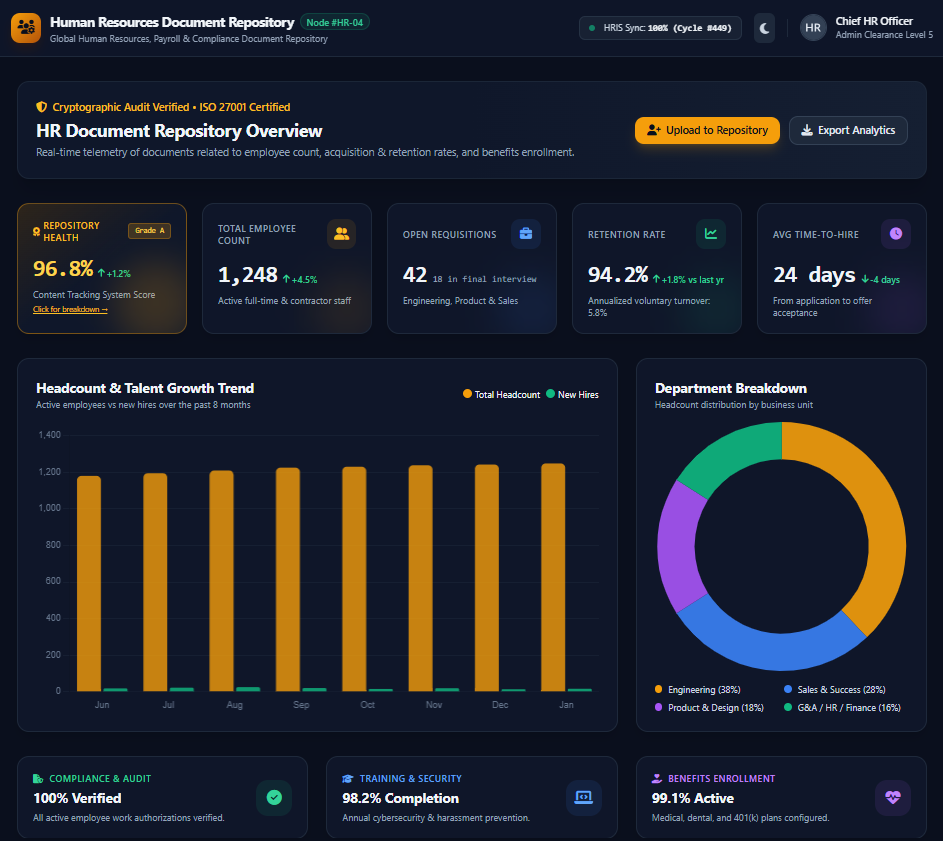
This is AI trained on your document respository to assess and score repository health based on KPI's configured by the HR department. Human Resources manages some of the most important and sensitive information within an organization. Employee information is often distributed across HR applications, document repositories, spreadsheets, workflow systems and historical records.
The AITS Content Tracking System (CTS) provides a convenient percentage score to provide confidence. This is done 24/7 for all documents and data as they are added to the repository(ies). If there is an issue, the AI will alert the appropriate people with recommended actions to take.
Applied IT Solutions helps organizations modernize this information environment without treating modernization as simply a replacement of the existing technology. The objective is to establish an ongoing healthy document repository with a structured information foundation that connects employee, position, organizational, compensation, learning, performance and workforce information while supporting privacy, security and governance requirements.
Modernization can begin with existing records and processes. Historical employee documents can be digitized, indexed, classified and connected to structured workforce information, while existing applications and processes can be assessed for integration, improvement or replacement. Open HR Illustrative Dashboard
The result is a progression from fragmented employee records to searchable information, integrated workforce data and more efficient and intelligent HR operations.
Build the Foundation Before Replacing the Technology
HR modernization starts with understanding information, processes, relationships and controls rather than simply selecting another application.
An employee, position, organizational unit, manager, compensation record, benefit, learning record, performance event and supporting document can together form a connected employee information lifecycle. When these relationships are understood and structured, organizations can make better decisions about what should be retained, integrated, automated or replaced.
Applied IT establishes the information structure first, then helps assess, clean, digitize, migrate and integrate information according to business value, operational requirements and information governance needs.
This reduces the risk of creating another collection of disconnected HR systems and provides a foundation for workflow automation, workforce analytics, employee self-service and responsible use of AI.
Human Resources Modernization Capabilities
Employee Information
Identify, structure and manage core employee information and relationships connecting employees, positions, organizational units, managers and employment events.
Employee Records
Modernize historical and current records from paper, scanned images, shared drives and legacy repositories while maintaining relationships and controls.
Searchable Records
Use indexing, metadata, OCR and structured information to make employee records and supporting documents easier to locate and use.
Information Integration
Connect core HR, payroll, learning, recruitment, performance, benefits, workforce management and document repositories.
HR Workflow
Implement structured workflows, automation, approvals, notifications, exceptions and auditable business rules for HR processes.
Data Quality
Validate, reconcile and monitor workforce information to identify inconsistent, duplicate, incomplete or outdated data.
Workforce Analytics
Provide reporting, dashboards, workforce measures and management information based on reliable and connected HR data.
Governance & Security
Support access control, privacy, security, auditability, retention and responsible management of sensitive employee information.
From Employee Records to Workforce Intelligence
Human Resources modernization is a lifecycle rather than a single system implementation. Applied IT helps organizations move through that lifecycle while preserving information integrity and maintaining appropriate human oversight.
Preserve
Protect historical employee records and maintain reliable digital representations of important workforce information.
Digitize
Convert physical and legacy HR records into structured digital information that can be managed and accessed efficiently.
Index
Apply metadata, employee identifiers and document classifications to make information searchable and consistently managed.
Connect
Connect employees, positions, organizational units, employment events and supporting documents across the information environment.
Validate
Measure data quality, reconcile information and establish confidence in the workforce information used by HR and management.
Automate
Apply workflows, business rules and automation while maintaining appropriate human review and control points.
Understand
Use analytics and governed AI to help authorized users identify information, patterns, exceptions and workforce trends.
Optimize
Continuously improve HR services and information processes using measurable operational outcomes and user feedback.
AI-Assisted Human Resources
AI becomes more useful when HR information has already been digitized, structured and governed. Applied IT can help organizations introduce AI capabilities incrementally on top of an information foundation that supports security, privacy and human oversight.
Document intelligence can help identify information within employee records, extract relevant fields, classify documents, summarize information and assist authorized users in locating related records.
AI can also support HR service delivery through knowledge discovery, policy navigation, workflow assistance, employee-service requests and structured workforce analysis.
These capabilities are intended to complement HR professionals rather than replace appropriate controls, privacy protections or human review. A structured information foundation allows organizations to introduce individual AI use cases incrementally, establish review points and measure operational outcomes.
Potential Use Cases
- Employee document classification
- Information extraction
- Employee record discovery
- Record discovery and search assistance
- Duplicate and anomaly identification
- Metadata enrichment
- Amendment and record comparison
- Workforce reporting
- Staff knowledge assistance
A Practical Path to Modernization
HR modernization does not need to happen as a single disruptive technology project. Applied IT supports an incremental approach that establishes value while reducing operational disruption and preserving continuity of employee information.
Discover
Understand existing HR systems, records, processes, information relationships and privacy, security and operational constraints.
Structure
Define the employee and workforce information model, identifiers, metadata and relationships required to manage information consistently.
Modernize
Digitize, clean, index, migrate and integrate prioritized HR information while maintaining business continuity and appropriate controls.
Optimize
Apply workflow, analytics, automation and governed AI where they provide measurable operational value.
HR Document Repository Modernization
One value of a Human Resources function depends on the integrity, accessibility, privacy and continuity of its workforce documentation. Modernization should improve how that documentation is managed and used without compromise.
Applied IT Solutions trains AI to your document repository to assess its health. This is the Content Tracking System (CTS) used to provide actionable intelligence to help organizations confidently move from fragmented HR documentation toward a structured and sustainable environment.
The destination is not simply a newer HR system. It is an HR information environment where authorized users can find, understand, connect and use workforce documentation efficiently and responsibly.