
AI Solutions That Work
Practical AI Brings Measureable Value
The AITS AI/ML Platform page describes the platform.
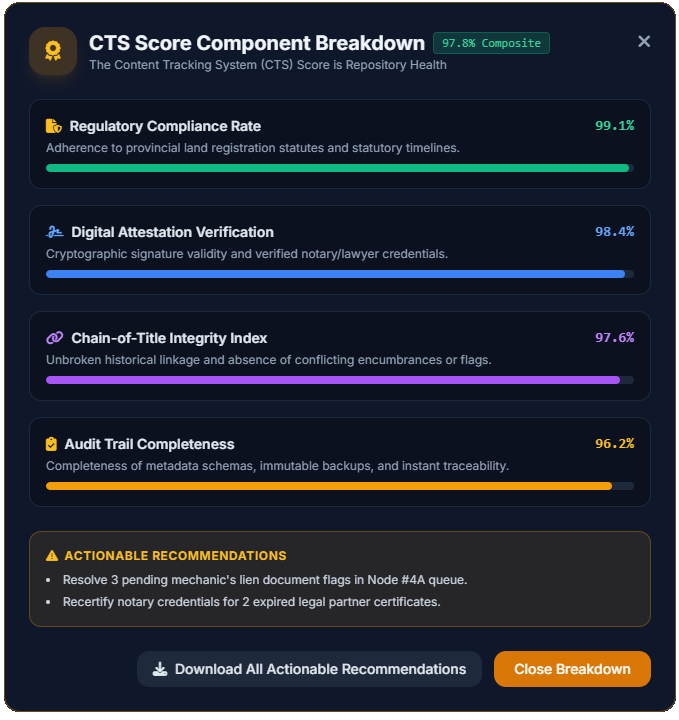
AITS has developed a Content Tracking System (CTS) that provides a health score at a glance. It is a composite index of all your weighted KPI's. This is AI at work, using the measuring stick you define to determine a way to be confident about what is in your repository. Moreover, the detailed composite index will show you what needs to be improved and how to go about it.
Your organization may already have years or decades of valuable information stored in document repositories. The problem may not be a lack of information. It may be that the information is difficult to find, inconsistently structured, poorly classified, duplicated, outdated or difficult to use.
The AITS Repository Health Check provides a practical assessment of your existing document and content repositories to help identify information quality issues, structural weaknesses, accessibility problems, governance considerations and opportunities to make your information more useful.
Repository Agnostic
AITS is repository agnostic. We do not begin by asking you to replace your document management system or move your information to a particular platform. We begin with the repository you already have and score its health according to your metrics. Read More...
Clear Objective = Clear Results
The objective is straightforward: understand what you have, understand its condition, identify what can be improved and determine where modern search, automation, analytics and AI can provide practical value.
Your repository may already contain the information needed to support the next generation of knowledge management and AI-enabled business processes. The Repository Health Check helps determine how ready that information actually is. From that point, as batch processes run to ingest more content into your repository, CTS will continue to monitor the overall health. It will score and send alerts should anything fall below acceptable thresholds.
Solution:
Example: Human Resources
Demo:
Human Resources Realtime Dashboard
How Does AI train to do a Repository Health Check?
Repository Health Assessment Areas
A repository can contain millions of documents and still provide poor access to the information inside them. CTS examines the factors that determine whether your information can be effectively managed, searched, governed, analyzed and used by modern applications and AI technologies. The result is a practical view of the current information environment and the opportunities available to improve it.
Content
Understand what information is stored, including document types, volumes, age, duplication, obsolete content and other characteristics of the repository.
Structure
Examine folders, libraries, collections, document types and organizational structures to identify inconsistencies and opportunities for improvement.
Metadata
Assess the availability, consistency and usefulness of metadata, classifications, identifiers and other information used to describe content.
Search
Identify barriers that make information difficult to locate, retrieve, understand or navigate across the repository.
Data Quality
Identify duplicate, incomplete, inconsistent, conflicting or potentially obsolete information that may reduce confidence in repository content.
Security
Consider access, permissions, information sensitivity and other controls that affect how content can be safely used and shared.
Governance
Examine ownership, classification, retention, lifecycle and other governance considerations affecting repository information.
AI Readiness
Determine whether the information environment provides an appropriate foundation for AI-enabled search, retrieval, analysis and automation.
Repository Agnostic
Organizations rarely have all of their information in one place. Enterprise repositories, departmental systems, network drives, cloud storage and application-specific document stores may all contain information that employees depend upon.
AITS does not require a particular document management platform. The Repository Health Check can be applied to a wide range of enterprise, specialized and file-based repositories.
Examples include:
Enterprise Content Management
Microsoft SharePoint and SharePoint Online, OpenText Documentum, OpenText Content Server, OpenText Extended ECM, IBM FileNet, IBM Content Manager, Hyland OnBase, Hyland Alfresco, Nuxeo, Oracle WebCenter Content, Newgen and SER / Doxis.
Cloud & Specialized Platforms
Box, Dropbox Business, Google Drive / Google Workspace, Egnyte, M-Files, Laserfiche, DocuWare, iManage, NetDocuments, Adobe Experience Manager Assets and other cloud or specialized content management platforms.
File & Application Repositories
Windows network file shares, NAS repositories, Azure Blob Storage, Amazon S3, Google Cloud Storage, custom-built repositories, line-of-business application document stores and other legacy information environments.
Why Repository Health Matters (CTS Score)
Artificial intelligence does not automatically fix poor information during a health check - that comes later. If the underlying repository contains duplicate documents, obsolete policies, inconsistent metadata, poor classification or inaccessible information, a CTS Health Check exposes risk.
AITS therefore looks at the respository health against your defined metrics and provides Actionable Recommendations. The assessment may identify opportunities for repository cleanup, metadata improvement, search optimization, information governance, automation or AI-enabled knowledge solutions.
If you want AI to fix it for you, CTS can do that too - prioritized by risk. Anything that needs your direct attention is called out while CTS fixes the smaller problems.
The caution here is to not introduce AI for its own sake. It is to determine where better information management and modern technology can provide measurable business value.
Potential Outcomes
- Improved search
- Better metadata
- Reduced duplication
- Improved information quality
- Stronger governance
- Better information access
- Automation opportunities
- AI readiness
From Repository Health to AI Opportunity
AI Search
Help employees find relevant information across approved repositories and information sources.
Knowledge Assistants
Allow employees to ask questions about approved organizational information using natural language.
Document Intelligence
Extract, classify, summarize and analyze information contained in large document collections.
Intelligent Automation
Use AI to classify information, extract data and support document-intensive workflows.
Content Analysis
Identify patterns, duplication, gaps, relationships and other characteristics within large information collections.
Metadata Enrichment
Use automated analysis to improve classification, metadata and the discoverability of existing content.
Information Insight
Use analytics and AI techniques to identify patterns, exceptions and opportunities within organizational information.
Governed AI
Apply appropriate security, privacy, access and human oversight controls to AI-enabled information solutions.
A Practical Path From Repository to Results
Discover
Understand the repository, information, structure, processes and operational requirements that define the current environment.
Assess
Identify information quality, metadata, search, accessibility, governance, security and AI-readiness considerations.
Prioritize
Identify the improvements and opportunities that can provide practical business value without assuming a platform replacement.
Optimize
Implement improvements and introduce automation, analytics and governed AI capabilities where they make sense.
Find Out Your Repository Health
Your organization already has valuable information. It may be sitting in SharePoint, Documentum, FileNet, OnBase, OpenText, iManage, network drives, cloud storage, line-of-business applications or several repositories at once.
You don't need to know which AI technology you need before starting the conversation. You don't necessarily need to replace your repository. And you don't need to have an AI strategy already defined.
Start with the information you already have. The AITS Repository Health Check can help identify what is working, where the problems are and where better information management, automation or AI may create value.
Contact AITS to discuss a Repository Health Check.